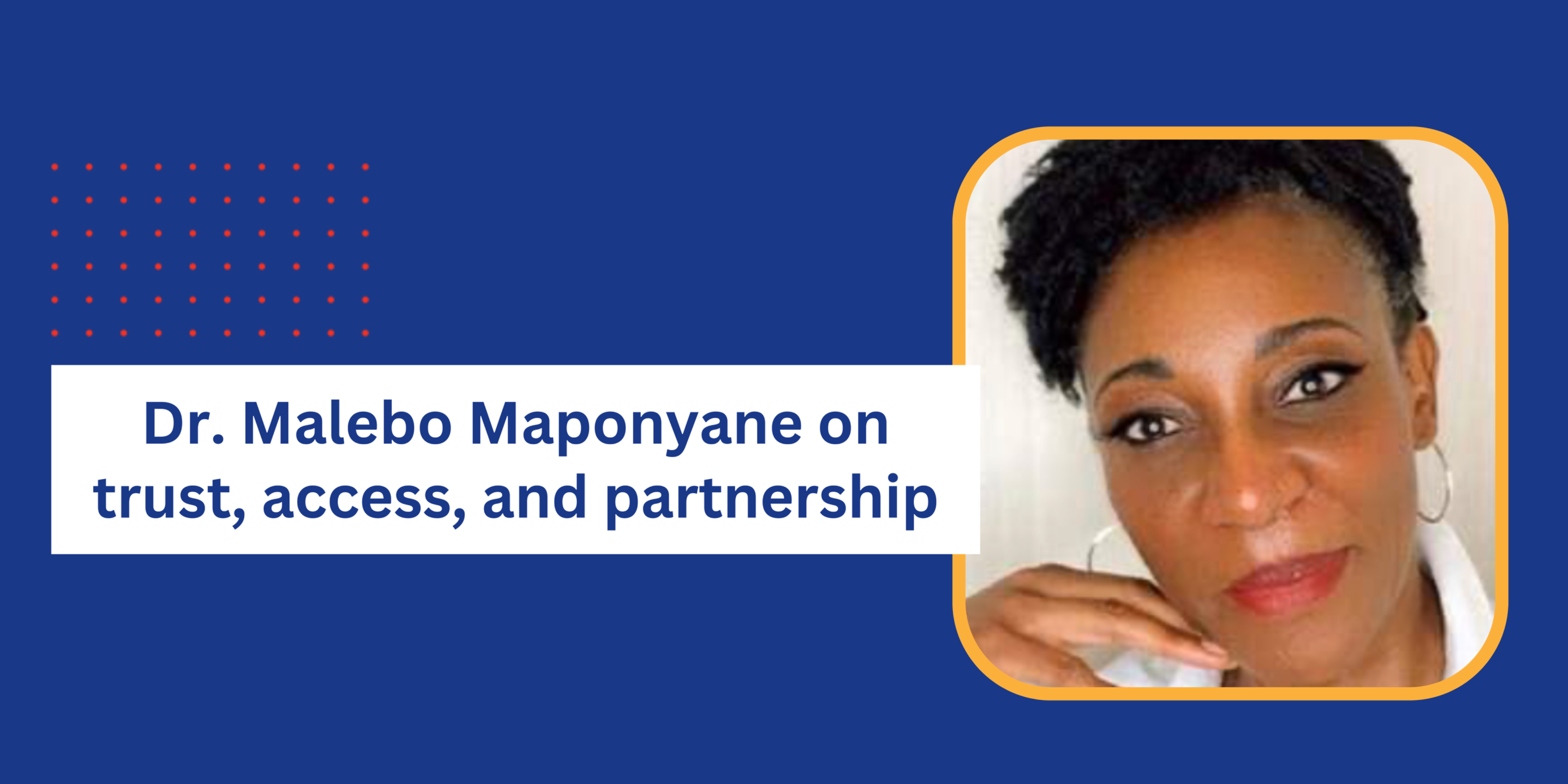
The queue started growing long before Rotary Family Health Day officially began in March 2026, in the Robega community. Community members kept arriving, eager to access health services brought together under one roof.
As the crowds grew throughout the day, Dr. Malebo Maponyane watched a belief she had held for decades come to life: when healthcare is brought closer to communities, and organizations work together rather than in isolation, people respond.
“It was beautiful. It was lively,” she recalls. “People were genuinely excited, and our community made our day.”
That program marked the Royal Bafokeng Administration’s, direct collaboration with the Rotary Action Group for Family Health & AIDS Prevention (RFHA) - the start of something bigger than a single health day, alongside our other key partners including Implats, Gift of the Givers, the National and Provincial Departments of Health, SANAC and other stakeholders.
A lifetime in public health
Finding a partner with the same vision
The partnership began by chance: Implats Group Executive for Health, Dr Bogosi Moagi invited Dr. Maponyane to the South Africa RFHD launch program in 2024, where she met RFHA CEO Sue Paget.
Implats is one of the world's foremost producers of platinum and associated platinum group metals (PGMs). They piloted the RFHD program in the Northwest province in October 2024.
“I was drawn in because what Sue was offering was exactly what I wanted to see happening in our community,” Dr. Malebo says. “It was a real opportunity for collaboration.”
What stood out wasn’t only RFHA’s commitment to community health, but how it worked: bringing multiple organizations together rather than delivering programs alone.
That collaborative model mirrors her own philosophy.
“We have seen the challenges within the public sector, and it doesn’t work for us to rely on government alone,” she says. “It makes much more sense for us to come together, instead of just handing over money and expecting it to meet objectives alone.”
Partnerships, she believes, should also raise standards across the board. “One of the things I would really like to see come out of this is best practice.”
More than a health event
Looking back, what Dr. Maponyane remembers most is the breadth of organizations involved.
“The big impact was the resources RFHA brought,” she says.
Partners including Gift of the Givers expanded the services on offer — ultrasounds alongside comprehensive screening that the Administration would have struggled to organize alone.
Many residents arrived expecting treatment rather than screening but embraced the day regardless; attendance kept growing as word spread, and our team couldn’t finish seeing everyone at their site. Even so, the collaboration achieved something important.
“It really laid good groundwork,” she says. “It built confidence in the work we are doing.”
That candour extends to what comes next.
“My team wasn’t as well prepared as we could have been, and we didn’t advertise ourselves well enough,” she admits.
Rethinking who healthcare reaches
Asked about health-seeking behaviour, Dr. Maponyane doesn’t start with disease, she starts with people.
“We’re still lacking very much in men accessing services,” she says.
Women attend. Older people attend. Men often do not. “For whatever reason,” she reflects, “men have taken on the idea that healthcare is for women and children.”
Part of the barrier is practical: “Our services tend to run during working hours, and that’s exactly when men are at work... by the time they knock off, the services are no longer available.”
But the design of services plays a role too. Discussing RFHA’s growing focus on gender-intentional healthcare, she reflects on how conversations about gender so often centre women and children and leave men out entirely.
“I think the fact that healthcare providers tend to be mostly female is also a barrier,” she says. “In some cases, men want to talk about how they are feeling, what they’re going through, but they can’t talk to women.”
Her answer is representation and design: “We need to make sure the healthcare providers themselves include men. It needs to be a good mixture and balance, so men feel more encouraged to come and open up.”
She also sees value in dedicated spaces for men at these events, since many engage more readily when a space is designed with them in mind. For her, gender-intentional healthcare isn’t a conversation about women and girls alone, it’s a chance to make care more accessible for everyone.
Preparing for tomorrow’s health challenges
Dr. Maponyane is already looking past HIV and TB toward a new set of priorities.
“Mental health is one of the biggest issues right now,” she says, noting that within many Black communities it’s still widely misunderstood. “We tend not to regard mental health as a real medical condition. We come up with all sorts of myths around it instead.”
As mining operations wind down, she expects the fallout to go well beyond employment — unemployment, gender-based violence, mental health strain, and rising non-communicable disease. The lessons learned through decades of HIV and TB work, she believes, now need to be applied there too.
A partnership built to last
Asked to sum up the partnership, she doesn’t hesitate: “The impact has been amazing, honestly. Community members loved it, and it’s definitely something we want to continue.”
For Dr. Maponyane, the lesson is simple: when organizations work together and communities are placed at the centre, healthcare becomes more than a service. It becomes a shared commitment to a healthier future.
Helping communities become informed, seek care earlier and benefit from stronger partnerships across the health system. If the response from the Royal Bafokeng community is any indication, this is only the beginning.
The RFHD Robega activation alone reached 1,549 beneficiaries, offering HIV testing, TB screening, maternal and child health services, among other key health services.
Want to be part of the next one? There are many ways to support RFHA's mission to save and improve lives.
Learn more and get involved: www.rfha.org or contact us at: [email protected]